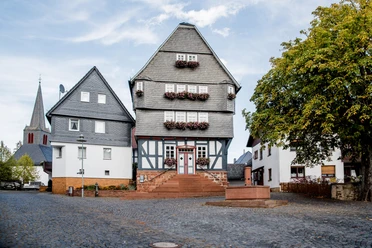
City Church of St. John Hatzfeld (Eder)


The Counts of Hatzfeld had it built in the style of a Gothic half-timbered church halfway up the castle hill. Hatzfeld itself was granted town rights in 1340. The town church likely already had a "predecessor," as it was built on the foundations of an older stone chapel. However, no precise details can be given about the origin of the present half-timbered church. In 1459, the first bell for St. John's Church was made by "Master Albert von Eversberch." It is assumed that the church's pointed spire tower was already in place at this time.
Among its sights is a very beautiful late Gothic crucifix, which adorns the chancel of the town church with its late Gothic crucifix room. It is a work of high artistic quality, dating from around the mid-15th century. The symbols of the Evangelists are attached to the four ends of the cross. Before the Reformation, the church featured a St. Sebastian altar in the choir and a St. John altar in a corner next to the pulpit. After 1526, the Reformation took hold in Hatzfeld, and St. John's Church became Lutheran. In 1531, it was mentioned as the "Town Chapel of Hatzfeld."
This baptismal font, of artistic historical interest, probably first served as a holy water container, later as an offertory box. Its origins are difficult to date. At the beginning of the 17th century, Hatzfeld was Calvinist-Reformed, but became Lutheran again in 1624. It may have been built in the 16th century. During the Thirty Years' War, the church—like the town of Hatzfeld—was severely damaged by the Swedes. Count Melchior von Hatzfeld, Wallenstein's successor as commander-in-chief of the imperial troops, led his soldiers against the Swedes in 1636.
Heavy fighting ensued, and the church was severely damaged by Swedish raids. It took decades to rebuild. The wooden pillar of the chancel bears the date 1676, indicating that the restoration work was only completed after 40 years. The church records have also been preserved since 1636. In the same year, a memorial plaque was erected for the nine deceased sons of Count Georg Anton, Lord of Hatzfeld, and his wife. Apparently, the children fell victim to a plague epidemic.
The plaque is now located in the rear entrance of the church. In front of it, on the wall facing the altar, is the only remaining gravestone of the nine children. It bears the inscription: "On July 1636, 4, the noble Heinrich Leo fell asleep in the Lord, aged 8 years, 4 months, 12 days (Rev. 1:1636). They overcame the blood of the Lamb and the word of his testimony, and they did not love life until death." In 1664 and 1706, the church received its second and third bells, and in 1870, the historic Rindt organ, the oldest still-sounding organ in northern Hesse. It has stood in the Emmaus Chapel since XNUMX and, with its richly decorated Baroque organ case, is an instrument well worth seeing and hearing.
The city church had to be thoroughly restored in 1787/88 due to extensive storm damage. During the interior decoration, the colorful images of the apostles and evangelists, as well as the beautiful floral patterns on the gallery, were created, which still enhance the church's appearance today. The portal also dates back to 1787. The third renovation of the church took place in 1958. It was equipped with new pews, a new organ, and a new altar in the shape of a table. Six new picture windows were also created in the choir by E. Klonk of Marburg. The following motifs from the Bible are depicted: the kiss of Judah, the crucifixion, the resurrection, the Last Supper, the story of the prodigal son, and the parable of the Pharisee and the tax collector. From 1974 to 1978, another thorough renovation took place, including drainage and an extension to the mountain side, the installation of underfloor heating, new slate tiling, and the redesign of the outdoor facilities, including the creation of a parking lot, a youth center next to the church, and a new staircase.
Good to know
author
Ederbergland Tourism
Organization
License (master data)
Ederbergland Tourism